
Surfboard Buying Guide Beginners: Surfboard Buying Guide for Beginners in 2026

You are standing in a surf shop with a rental board under one arm, a credit card in the other, and three completely different surfboards leaning against the wall. One is short and sharp. One looks like a giant foam toy. The third costs more than your first flight to the coast. I have made enough bad board choices to know this: your first surfboard should make catching small waves easy, not make you look advanced on the beach.
The best beginner board is long enough to paddle easily, wide enough to balance on, and thick enough to float your weight without constant correction. Spend money on stability first. You can chase speed and sharper turns later.
How much surfboard volume does a beginner need?
Start with stability, not board length
Beginners usually focus on length because it is easy to understand. A 9-foot board sounds more stable than a 7-foot board, and that is often true, but length alone does not tell you how well the board will float. Width, thickness, outline, and volume all matter.
For a first board, I usually want at least 0.7 to 1.0 liters of volume per kilogram of body weight. A 75-kilogram beginner should look at roughly 55 to 75 liters. A heavier adult may need 75 to 100 liters. Those numbers are a starting point, not a reason to reject a board with a good shape.
My clear beginner rule is simple: choose more volume if you are unfit, older, carrying extra weight, or learning in weak waves. Choose less volume only if you already have strong balance from skating, snowboarding, or similar sports and will surf in clean, powerful waves.
Why a wide board catches more waves
A wide middle gives you a larger platform when you paddle and stand. A fuller nose keeps the board from sinking when your weight moves forward. A flatter rocker helps the board glide across slow water instead of pushing its nose into every small wave.
Those features solve the real beginner problem: not turning sharply, but getting enough speed to stand up before the wave passes underneath you. A board with 70 liters and a stable outline can be easier than a narrow board with 80 liters.
For most adults, I would begin with a soft board between 8 and 9 feet long. Shorter boards can work for small, light riders, but a short board makes every early mistake more expensive. You will fall more, catch fewer waves, and spend more time wondering why surfing looks easy for everyone else.
Soft top versus hard top: which board should you learn on?
Choose a soft top for the first stage
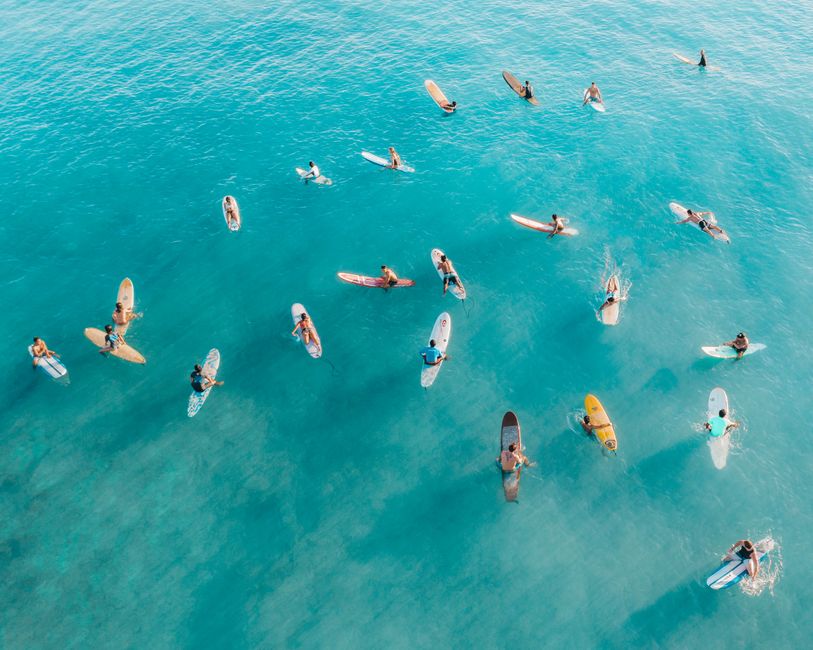
A soft-top surfboard is the right first choice for most beginners because it reduces the cost of mistakes. The deck is forgiving when your knees, elbows, or head meet the board. The rails are usually rounded, the fins are less intimidating, and the board handles beach breaks with less drama.
That safety matters when you are learning in a crowded lineup or taking lessons with friends. You can focus on paddling, looking down the line, and standing with your feet in the correct position instead of protecting a fragile fiberglass deck.
Know the tradeoff before you upgrade
Soft boards are not perfect. Some track in a straight line, feel heavy under your arm, and resist tight turns. Cheap models can have weak fin boxes, slippery decks, or seams that open after a season in hot car trunks. A soft top also takes more space on a roof rack.
A hard board makes sense after you can reliably catch unbroken waves, trim left and right, and return to your feet without freezing. The common mistake is buying one too early because it looks more serious. A hard board that you cannot paddle or balance on is not a better board. It is an expensive lesson.
Verdict: learn on a soft top unless you already surf confidently or have regular coaching on a specific hard-board shape. The extra forgiveness is worth more than the sharper performance.
Four beginner surfboards worth comparing in 2026
The useful comparison
These boards cover the main choices beginners face: low-cost foam, higher-quality foam, a durable funboard, and a more responsive epoxy option. Prices change by shop and season, so treat them as current reference points rather than permanent guarantees.
| Board | Size and volume | Listed price | Best use |
|---|---|---|---|
| Wavestorm 8ft Classic | 8 feet, about 86 liters, roughly 22.5 inches wide | About $200 to $250 | Lowest-cost first board for small waves and casual use |
| Softech Roller 2.0 | 7 feet, 70 liters, 22.25 inches wide | $395 | Stable learning with better construction and included fins |
| Catch Surf Odysea Log | 7 feet, 72 liters, 22 inches wide | About $474.99 | Durable foam board for frequent use and playful waves |
| Torq TET Mod Fun | 7 feet 2 inches, 47.2 liters, 21.25 inches wide | Usually sold at a higher mid-range price | Progression board for lighter or already athletic beginners |
My picks from the table
For a tight budget, I would buy the Wavestorm 8ft Classic and spend the saved money on lessons. Its 86 liters give a new surfer plenty of stability, and a used one can be even better value if the deck and fin boxes are intact.
For the best all-around soft board, I prefer the Softech Roller 2.0 in the 7-foot size. Its 70 liters and broad outline make it stable without feeling like a full beginner-school longboard. The Catch Surf Odysea Log is my pick for a heavier adult or someone who wants maximum wave count. The 72-liter 7-foot version has enough float to make weak beach-break waves enjoyable.
The Torq TET Mod Fun is the board I would choose only for a lighter, fit beginner who expects to progress quickly. Its 47.2 liters are much less forgiving than the foam boards. It is more capable once your technique improves, but it will punish a first-week surfer who still struggles to paddle straight.
How to buy your first surfboard without wasting money
Use this five-step check before paying
- Measure your body weight. Use your actual weight with a wetsuit, not your optimistic target weight. A board that floats you well will make learning faster.
- Check the local waves. Slow, rolling beach-break waves need more length and volume. Steep, powerful waves can support a shorter board, but they are less forgiving for a new surfer.
- Inspect the deck and rails. On a used soft board, look for deep foot dents, exposed foam, loose rails, soft spots, and water inside the board. Walk away from a board that feels swollen or heavy.
- Confirm the included parts. Ask if fins and a leash are included. Replacing both can add $50 to $150 to a bargain purchase. A leash should match the board length and local wave size.
- Make sure you can transport it. An 8-foot board needs safe storage and a suitable roof rack or vehicle. A board that stays in the garage is not a good deal.
Do not spend the whole budget on the board
Keep money aside for a leash, fins, roof straps, wax if the deck needs it, and at least one lesson. A beginner with a basic board and good instruction will improve faster than a beginner with an expensive board and no idea where to sit in the lineup.
Also check the return policy before ordering online. Surfboards are awkward to ship, and a size mistake can cost more to return than the original delivery. If possible, stand beside the board, place your chest over the middle, and ask a local instructor if the outline fits your size and waves.
The used-board rule I follow
Buy used when the seller lets you inspect the board in person. Do not buy used from a dark photograph that hides repairs. A clean $150 soft board with intact fins is better than a damaged $400 board with a fashionable logo.
When should a beginner skip the biggest board?
Skip the biggest board when storage and travel are real problems
There is a point where extra length stops helping. If you fly to surf destinations, drive a small car, or carry the board down a long path to the beach, an 8-foot or 9-foot board may become a practical burden. In that case, a stable 7-foot board with enough volume can be the smarter purchase.
That is why I prefer the Softech Roller 2.0 7-foot for many traveling beginners. Its 70 liters keep the learning curve friendly, but the shorter length is easier to move and store. The Catch Surf Odysea Log 7-foot gives a similar idea with 72 liters and a durable soft construction. Both are more practical than a giant board for someone who surfs on weekends and travels often.
Q: Should a small adult buy a 6-foot board?
Only if that rider is light, athletic, and prepared for a slower start. A 6-foot foam board can look manageable on land but feel unstable once the water moves. For most adults under 65 kilograms, I would still favor a 7-foot board with at least 60 liters unless an instructor recommends something smaller after watching them surf.
Q: Should a bigger adult buy a 9-foot board?
Usually, yes. A heavier beginner needs more volume and a wider platform, not a shorter board that looks easier to carry. A 9-foot soft board with 90 to 100 liters can make paddling, standing, and balance far easier. The larger board also gives you a better chance of catching slow waves, which is where beginners learn the most.
Q: When should I move to a hard board?
Move when you can catch waves without help, trim in both directions, and control the board after a fall. For many people, that takes several months of regular surfing. If you make the switch too soon, keep the soft board. It remains useful for small days, crowded beaches, and teaching friends.
The single most important takeaway is this: buy the biggest stable board you can comfortably transport, because wave time builds skill faster than a short board ever will.